Predicting the evolution of species in novel environments
Genomic prediction of plant evolution under climate change
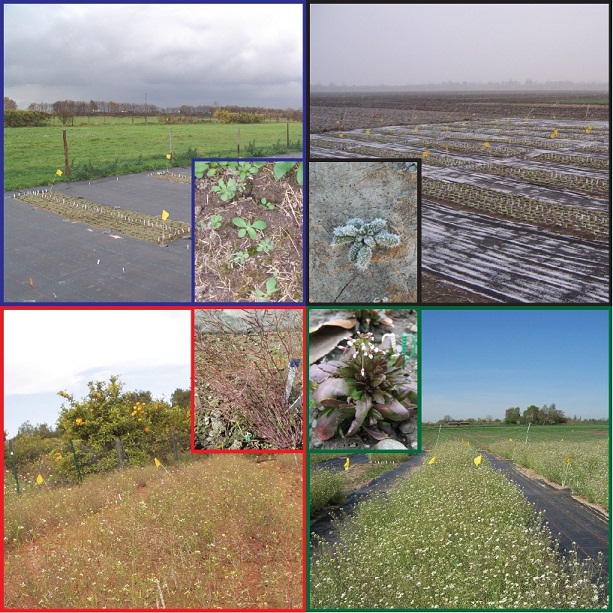
Foundational work demonstrated that natural variation in fitness across European climates is underlain by genomic regions with strong environment-specific effects, and that the adaptive significance of flowering time plasticity, as a highly heritable trait driving fitness, strongly responds to these local climates (Fournier-Level et al. 2011, Science; Fournier-Level et al. 2022, New Phytologist). Building on this framework, we generated genome-informed forecasts of trait responses for diverse plant genetic makeups sourced from across the native range, providing a practical tool for seed provenancing decisions in restoration and conservation contexts (Putra et al. 2023, Molecular Ecology Resources).
The AraCast application below lets you explore these forecasts interactively, comparing predicted trait values and evolutionary trajectories across populations and climate scenarios.
Invasion genomics of common ragweed
Invasive species are natural experiments in rapid evolution: founding populations are identifiable, the timescale of spread is documented, and novel selection pressures can be inferred from the environments colonised. Common ragweed (Ambrosia artemisiifolia) is a globally invasive annual plant that has spread across Europe and into Australia from a North American origin, rapidly adapting to a wide range of climates and becoming a major agricultural weed and allergen. In collaboration with Kathryn (Kay) Hodgins (Monash University) and John Stinchcombe (University of Toronto), we use ragweed's global invasion as a tractable system to ask how genomic diversity shapes invasion outcomes and whether patterns of adaptation in the native range can be used to forecast trait expression and establishment potential in invaded environments.
This programme is being developped by first integrating population genomics structure into ecological niche modelling, showing that the genomic composition of founding populations has predictable consequences for invasion potential: some source genotypes are better matched to invaded environments than others, and this can be quantified from genome-wide variation before introduction events occur (Putra et al. 2024, Evolutionary Applications). Second, by examining trait architecture across the native and invasive range, we found that the genetic basis of key functional traits is variable across populations, which places fundamental limits on how well cross-range genomic predictions can perform — a caution for any programme that seeks to extrapolate trait-based forecasts beyond the populations used for model training (Putra et al. 2026, Evolutionary Applications). Together, this work illustrates both the promise and the constraints of genome-based approaches for forecasting evolutionary dynamics in novel environments.
-
 Andhika Putra, PhD
 -
 Prof. Johanna Schmitt, UC Davis
 -
 Prof. Kathryn Hodgins, Monash University
 -
 Prof. John Stinchcombe, University of Toronto
People involved
Collaborators